Land vs Apartments : Which Investment Builds Better Long-Term Wealth?

Real estate remains one of the most powerful wealth-building tools in India. But one of the most common investor dilemmas is :
Should I invest in land or buy an apartment?
Both options have strong advantages — but they serve different financial goals. If you are investing in Bangalore or any fast-growing urban market, understanding the long-term implications of each is critical.
This detailed guide breaks down appreciation potential, rental returns, risks, liquidity, maintenance, taxation, and long-term wealth creation.
🏗️ Understanding the Core Difference
🟢 Land (Plots / Sites)
- 🔴 You own the land outright.
- 🔴 No construction unless you choose to build.
- 🔴 Value is primarily driven by location and infrastructure growth.
🟢 Apartments
- 🔴 You own a built-up unit within a larger project.
- 🔴 Includes shared amenities and common areas.
- 🔴 Value depends on both land share and building condition.
📈 1. Appreciation Potential : Which Grows Faster?
🟢 Land Appreciation
Land typically appreciates faster over the long term, especially in developing corridors.
Why?
- 🔴 Land supply is finite.
- 🔴 Infrastructure expansion increases demand.
- 🔴 No structural depreciation.
- 🔴 Higher speculative upside in growth zones.
In Bangalore, plotted developments near upcoming metro lines, STRR, or tech parks often show strong appreciation cycles within 5–8 years.
🟢 Apartment Appreciation
Apartments appreciate more slowly because :
- 🔴 The building depreciates over time.
- 🔴 Maintenance quality impacts resale value.
- 🔴 New launches create competition.
However, apartments in prime locations can still show steady appreciation.
Verdict (Long-Term Growth) :
✔ Land generally outperforms apartments over 10–15 years.
💰 2. Rental Income : Which Generates Cash Flow?
🟢 Apartments
- 🔴 Immediate rental income (if ready-to-move).
- 🔴 Consistent tenant demand in IT corridors.
- 🔴 Easier to lease compared to raw land.
Typical rental yield in Bangalore :
- 🔴 3%–5% annually.
🟢 Land
- 🔴 No rental income unless constructed.
- 🔴 Pure capital appreciation play.
Verdict (Cash Flow) :
✔ Apartments win for regular rental income.
🏦 3. Investment Entry & Affordability
🟢 Land
- 🔴 Often lower entry price in developing areas.
- 🔴 No EMI pressure from construction.
- 🔴 Lower ongoing costs.
🟢 Apartments
- 🔴 Higher ticket size in prime locations.
- 🔴 EMI + maintenance charges.
- 🔴 GST applicable on under-construction units.
Verdict (Initial Affordability):
✔ Land is often more flexible for early investors.

🔧 4. Maintenance & Ongoing Costs
🟢 Land
- 🔴 Minimal maintenance.
- 🔴 No association charges.
- 🔴 Low annual property tax (in many areas).
🟢 Apartments
- 🔴 Monthly maintenance fees.
- 🔴 Sinking fund contributions.
- 🔴 Renovation costs over time.
Verdict (Low Maintenance Wealth Holding) :
✔ Land requires less ongoing expense.
🏚️ 5. Depreciation Factor
This is a major long-term differentiator.
🟢 Land
- 🔴 Does not depreciate.
- 🔴 Value purely tied to location demand.
🟢 Apartments
- 🔴 Building depreciates 2%–5% annually.
- 🔴 Requires upkeep to retain value.
After 20 years, older apartments may struggle to compete with new launches unless in prime locations.
Verdict (Asset Longevity) :
✔ Land retains intrinsic value better.
🔄 6. Liquidity & Resale Ease
🟢 Apartments
- 🔴 Easier to sell in active rental markets.
- 🔴 Attractive to end-users.
- 🔴 Banks readily finance buyers.
🟢 Land
- 🔴 May take longer to sell unless in high-demand area.
- 🔴 Buyer pool smaller than apartment buyers.
Verdict (Resale Liquidity) :
✔ Apartments are usually easier to liquidate quickly.
📊 7. Risk Factors
Land Risks
- 🔴 Title disputes.
- 🔴 Conversion issues.
- 🔴 Zoning restrictions.
- 🔴 Delayed infrastructure development.
Apartment Risks
- 🔴 Builder delays.
- 🔴 Construction quality issues.
- 🔴 High-density competition.
- 🔴 Maintenance mismanagement.
Proper due diligence and legal verification are critical for both.
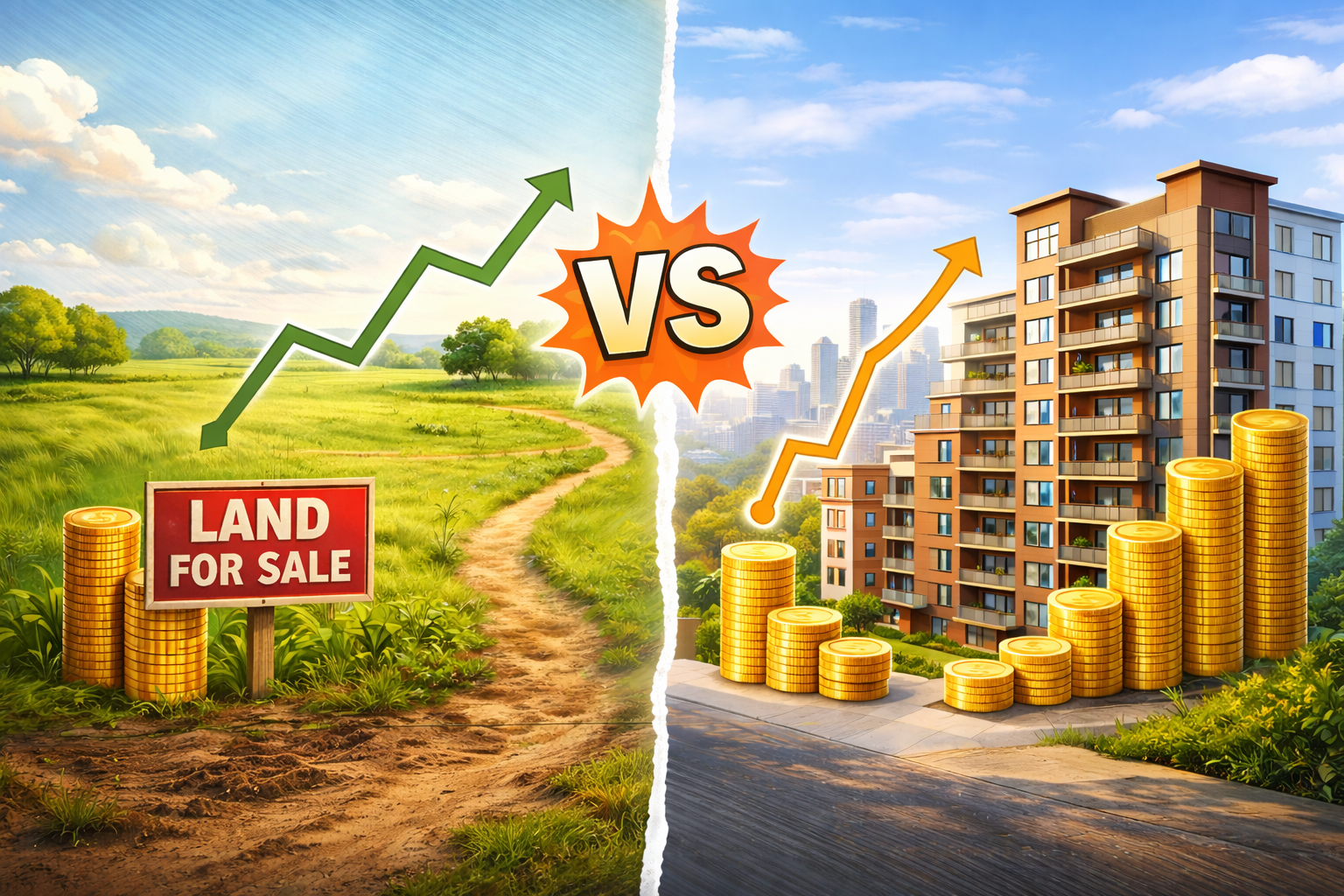
🧭 8. Investment Horizon Matters
| Investment Goal | Better Option |
|---|---|
| Short-Term (3–5 years) | Apartment |
| Rental Income | Apartment |
| Long-Term Wealth (10+ years) | Land |
| Low Maintenance | Land |
| Fast Liquidity | Apartment |
| Capital Growth Play | Land |
🏙️ Bangalore Market Perspective
In Bangalore’s current growth phase :
- 🔴 Emerging corridors (North & East Bangalore) → Land investments show strong potential.
- 🔴 Established IT hubs (Whitefield, Sarjapur, Electronic City) → Apartments generate steady rental yield.
- 🔴 Premium central zones → Limited land availability = strong appreciation.
.
Many seasoned investors follow a hybrid strategy :
- 🔴 Buy land early in growth corridors.
- 🔴 Buy apartments in high-rental demand zones.
Professional advisory firms like Kalindi Estates help investors evaluate which asset aligns with their financial goals and risk appetite.
🧠 So, Which Builds Better Long-Term Wealth?
If your goal is :
- 🔴 Wealth multiplication over 10–15 years → Land wins.
- 🔴 Stable rental income and moderate appreciation → Apartments win.
But the smartest strategy is not choosing one blindly.
The best investment depends on your time horizon, risk tolerance, and financial planning.
✅ Final Thought
Real estate is not about buying property — it’s about buying the right type of property at the right stage of growth.
Land builds wealth quietly and powerfully over time.
Apartments generate income and provide stability.
If chosen wisely, both can become strong pillars of your long-term financial success.
Related Post